
The short answer
Between £6,500 and £45,000.
Most domestic flat roofs land between £10,000 and £20,000.
I know that’s a wide range, and I know it isn’t the answer you were hoping for. So rather than leave it there, here is what we have actually been quoting over the last six months, by roof size.
| Roof size | Typical total price | What this usually is |
|---|---|---|
| Under 15m² | £7,500 – £16,000 | Garage, porch, dormer |
| 15 – 30m² | £6,500 – £20,000 | Single-storey rear extension |
| 30 – 50m² | £10,000 – £25,000 | Large extension or wraparound |
| 50 – 100m² | £14,000 – £32,000 | Very large, or several areas |
| 100m² + | From £24,500 | Major domestic or small commercial |
Where these figures come from: every domestic flat roof we quoted between February and July 2026. Not estimates, not industry averages, and not a marketing range. These are our own quotations, and we review them twice a year.
Around one job in ten falls outside these ranges, usually at the top end where access is difficult or the structure underneath turns out to need serious work. If yours is one of those, we’ll tell you why.
All figures exclude VAT. On most warm roof installations there is no VAT to add at all, and I’ll explain why shortly.
Why can’t we just give you one price per square metre?
Because the price per square metre falls as the roof gets bigger.
A lot of the cost on any job is fixed no matter how big the roof is. Scaffolding. The survey. Getting a crew and materials to site. Minimum material quantities.
On a small garage roof, those fixed costs are spread over very few square metres, so the rate looks high. On a large roof, the same costs are spread thin.
That’s why one flat rate would be misleading. It’s also why anyone who quotes you a single price per square metre hasn’t looked at your roof properly.
The surprise most people get
Look again at the first two rows of that table. A garage roof under 15m² and a full extension roof of nearly twice the size cost roughly the same.
That catches people out, and it’s worth understanding before you get a quote. Halving the size of a roof does not halve the price. The scaffold still goes up. The survey still happens. The crew and materials still travel. Below about 30m², those fixed costs dominate, and the roof itself is a surprisingly small part of the bill.
If you’re weighing up whether to do a small roof now or wait and do a larger area later, that’s worth knowing. Doing two small roofs separately costs considerably more than doing both at once.
One warning before you go any further
You’ll see flat roofs advertised “from £3,000”.
Across every domestic roof we have quoted in the last six months, the lowest price on a 15–30m² roof was £6,159. Nothing came close to £3,000.
A properly scaffolded, fully insulated, compliant flat roof on a typical extension starts closer to £7,000. If someone is quoting you half that, something is being left out.
The rest of this guide shows you what.
What this guide covers
Seven things decide where your roof falls in those ranges:
- The size of your roof
- Access to it
- Height and safety
- Whether you’re refurbishing or building new
- The system you choose
- Waste removal
- The installer you pick
Before we get to them, there’s one thing worth understanding. It will change how you read every quote you receive.
The Thing Almost Nobody Asks About
Most people buying a flat roof focus almost entirely on the product. Which membrane is best? How long does EPDM last? Is fibreglass better than felt? These are reasonable questions, and every roofing company will happily answer them, usually by explaining why the system they happen to sell is the best one.
Here’s what we’ve learned across more than 6,000 flat roof installations:
There is no perfect flat roof system. Every single one carries risk.
Not “some of the cheap ones”. All of them. Including the one we manufacture ourselves.
Felt is inexpensive and widely available. It’s also dimensionally unstable, vulnerable at upstands and edge details, and installed with a naked flame.
GRP fibreglass is strong and seamless. But it’s mixed on site, won’t bond to a substrate that isn’t bone dry, can only be laid within a narrow temperature range, and is prone to cracking where the building moves.
Single ply membranes, a family that includes EPDM rubber, PVC and TPO, are the most durable systems we install. Quality varies enormously between products though, and every one of them depends on how the joints are formed. A membrane is only as good as its seams.
“Single ply” doesn’t tell you what you’re buying
If you gather three quotes and they all say “single ply”, it’s natural to assume you’re comparing the same thing at different prices. You almost certainly aren’t.
Single ply is a category, not a product. It covers EPDM rubber, PVC and TPO membranes, in different thicknesses, in reinforced and unreinforced grades, fully bonded or mechanically fixed, and at wildly different qualities within each of those.
Take PVC as the example. PVC is kept flexible by plasticisers, and over time those plasticisers migrate out of the sheet. As they go, the membrane stiffens, shrinks and eventually cracks.
This isn’t our opinion. It’s well documented in the published research. A peer-reviewed study of PVC roofing membrane durability puts it plainly: loss of plasticisers causes embrittlement in PVC sheets, and it can be controlled by using high-molecular-weight plasticisers that are less inclined to evaporate or migrate out.
Read that second part again, because it’s the whole point. The problem is controllable. It’s controlled by using better, more expensive plasticisers.
So a cheap PVC membrane is cheap for a reason. It goes brittle sooner, and it starts to split and leak long after the contractor who fitted it has moved on. On the day it went down, it will have looked identical to a quality membrane.
Then there’s the welding. Single ply seams are heat-welded, and doing it properly is a genuine skill. The wrong temperature, the wrong speed, or an inexperienced hand, and the seam simply doesn’t achieve full fusion. It may not leak for years. It will eventually.
So “single ply” on a quotation tells you very little. What matters is the specific membrane, its thickness and grade, whether it’s reinforced, how it’s fixed, and who is welding it. Ask for those details on every quote you receive. A contractor who can answer without hesitating is one worth talking to. One who can only tell you the category is telling you something too.
So if every system carries risk, what actually decides whether your roof lasts?
How that risk is managed.
Look back at that list. Almost every failure mode is a decision, not a defect:
- Felt fails at upstands, because of how the detail was formed
- GRP delaminates, because it went down on a damp deck or in the wrong weather
- Single ply fails at seams, because of who held the welder and at what temperature
- A cheap membrane goes brittle, because of what was specified and by whom
None of those are the material’s fault. Every one of them is a choice made on a roof, on a particular day, by a particular person.
This is why two identical roofs, same system, same materials, can have completely different lifespans. And it’s why “which system is best?” is the wrong question. The right question is this: who is managing the risks that come with whichever system I choose, and how?
The proof is in the guarantee
Here’s the detail that settles it, and you can check it yourself on any quote you receive.
A manufacturer’s guarantee covers the product. It does not cover your roof.
Think about what that tells you. If the material were the thing that determined whether a roof performs, manufacturers would guarantee the finished installation without hesitation. They don’t, because they know perfectly well where the risk actually sits. They’ll stand behind their membrane. They won’t stand behind the person fitting it.
So when a contractor waves a “20-year manufacturer’s guarantee” at you, ask the follow-up question: if this roof leaks in year six because of how it was installed, who pays? If the answer involves the manufacturer blaming the installer and the installer blaming the manufacturer, you’ve found the gap that most flat roofing disputes fall into.
What this means for us, and for the price you’ll be quoted
We install every major system, so we have no stake in convincing you one of them is flawless. What we sell is not a membrane. It’s the management of the risks that come with whichever membrane is right for your roof: the survey that finds the rotten deck before it’s covered over, the specification that suits your building, the scaffolding that keeps the crew safe and working properly, the trained installer, and the accountability afterwards.
That is where the money in a proper quote actually goes. It’s also precisely what’s missing from a cheap one.
And this is where most contractors ask you to take their word for it
“We’re thorough.” “We do things properly.” “You’re in safe hands.” Every roofing company says it. None of them show you what it means.
So we built a process and we publish it. It’s called V8, and there are two versions. If your roof already exists, the V8 Assessment scores it against eight criteria and tells you what it actually needs. If you need a new roof, the V8 Design Process takes it through eight steps from brief to handover. Both are set out at the end of this guide.
One thing worth knowing now: the assessment doesn’t always conclude that you need a new roof. More on that shortly.
Keep this in mind as you read the seven factors below. Every one of them is really a question about risk. Who’s carrying it, who’s managing it, and what happens when something goes wrong.
1. The Size of Your Flat Roof
You’ve seen the size bands at the top of this guide. Two things are worth adding.
The ranges are wide, and deliberately so. They’re honest. Two roofs of identical size can differ by a factor of three depending on access, height, the condition of what’s underneath, and the system chosen.
Everything below explains what moves you up or down within your band.
A word on VAT
Most quotes you receive will have VAT added at 20%. Ours often doesn’t.
Where we install a warm roof, meaning a new roof with an insulation upgrade, the work counts as installing energy-saving materials in a residential property. That is currently zero-rated for VAT.
On a £12,000 roof, that’s £2,400 you don’t pay.
This isn’t a discount we’ve invented and it isn’t a loophole. It’s a government relief, applied properly, on work we’d be specifying anyway. A warm roof is what Building Regulations Part L requires on most replacement roofs over heated space.
Two caveats. It applies to residential properties, not commercial premises. And the relief is currently due to end on 31 March 2027, after which it goes to 5%. Straightforward repairs, or a recover with no insulation upgrade, are standard-rated as normal.
2. Access to Your Flat Roof
Not every flat roof is a single-storey extension with easy access and free parking outside.
We once completed a 13-storey roof in the middle of the City of London where the only access was a lift available two hours a day. That job cost considerably more than a comparable roof on a suburban bungalow. Not because the roof was different, but because everything around it was.
The less accessible your roof, the more equipment, manpower and time the project needs. Restricted access also adds planning time. If people, materials and waste have to move through the building, floors and walls need protection and logistics need a plan.
All of that time and resource is reflected in the price.
3. Height and Safety Considerations
Working at height is regulated by law in the UK, and for good reason. Falls from height are consistently the leading cause of fatal injury in the construction industry.
Three pieces of legislation govern how your flat roof project must be run:
- The Health and Safety at Work etc. Act 1974 places a legal duty on every business to protect its workers and anyone affected by its work. That includes you, your family and your building’s occupants.
- The Work at Height Regulations 2005 require all work at height to be properly planned, supervised and carried out using suitable equipment that prevents falls. For roof work, that almost always means scaffolding with edge protection. Not a ladder and good intentions.
- The Construction (Design and Management) Regulations 2015 (CDM 2015) apply to every construction project, including domestic ones. On a domestic job, the contractor carries the client’s legal duties, which means your roofer is legally responsible for planning and managing the work safely.
We scaffold every job. No exceptions. Not the “quick” ones, not the single-storey ones, not the ones where someone says it’ll be fine. Compliant scaffolding, erected by competent scaffolders, is how we protect our workers, your property and the people below.
Here’s the honest trade-off. This policy makes some of our quotes higher than others you’ll receive. On a small single-storey roof, scaffolding can add several hundred pounds that a corner-cutting competitor simply leaves out. We’d rather tell you that plainly than win the job by pretending the cost, or the risk, doesn’t exist.
This matters when you’re comparing quotes. If one price comes in noticeably cheaper, check whether it actually includes compliant access. Skipping or skimping on scaffolding is one of the most common ways cut-price operators make their numbers work, and it puts you, as the property owner, uncomfortably close to an illegal worksite.
You’ve probably already seen the problem on your phone
Spend five minutes on TikTok or Instagram and you’ll find roofing crews proudly filming themselves at height with no scaffold, no edge protection and no fall prevention of any kind. Trainers on a parapet, a ladder leaned against a gutter, “no fear” in the caption. It gets likes. It’s also, in almost every clip, a breach of the Work at Height Regulations, filmed and published by the people breaking them.
When it goes wrong, and falls from height are how roofers die, it isn’t only the operative who pays. The job stops, the HSE gets involved, and the customer is left with an open roof, a crime scene where their project used to be, and a contractor who was never insured for any of it.
If a roofing company is happy to break the law on camera for content, ask yourself what they’ll do on your roof when nobody’s filming.
Your responsibilities, and your risks, as the customer
If you’re a commercial client, meaning a landlord, managing agent, facilities manager or business owner, CDM 2015 places legal duties directly on you. You must make suitable arrangements for managing the project, appoint contractors with the skills and experience to do the work safely, and allow adequate time and resource for it to be done properly. Commercial clients can be, and are, prosecuted when they cut corners on contractor selection. “The roofer said it was fine” is not a defence.
If you’re a homeowner, the law is kinder to you. Under CDM 2015 your client duties transfer automatically to the contractor. But that protection only works if you’ve appointed a competent, insured contractor in the first place. Choose badly and the practical risks come home anyway:
- If an uninsured operative is injured or your property is damaged, claims and costs can end up at your door rather than an insurer’s.
- If the HSE stops unsafe work mid-project, you’re left with a stripped, exposed roof and no lawful way for that contractor to finish it.
- Work done by non-compliant, uninsured contractors can complicate or jeopardise your own home insurance position.
The cheapest quote is rarely a neutral choice. You’re not just buying a roof. You’re choosing whose safety practices, insurance and legal compliance will be operating on your property.
“But they said they’re insured”
Here’s the part almost nobody tells you. Having an insurance certificate and having insurance that will actually pay out are two different things.
Contractor insurance policies are written on the assumption that the contractor works legally. They routinely contain conditions requiring compliance with statutory requirements, including the Work at Height Regulations. A contractor working on your roof with no scaffold and no edge protection isn’t just breaking the law. They’re handing their insurer grounds to decline any claim that arises from that work.
So when something goes wrong on a non-compliant job, and a worker falls, or a wall is damaged, or a passer-by is hurt, there’s a real possibility the insurance that was supposed to protect everyone simply doesn’t respond. The claim doesn’t disappear. It just lands on whoever’s left: a contractor with no assets, and a property owner with a problem.
Before you accept any roofing quote, ask three questions:
- Is scaffolding included in this price, and if not, why not?
- Can I see your public liability insurance, and does it cover the way you actually intend to do this job?
- Who is legally responsible if someone is injured on my property during this work?
A professional contractor answers all three without blinking. Watch what happens when a cheap one is asked.
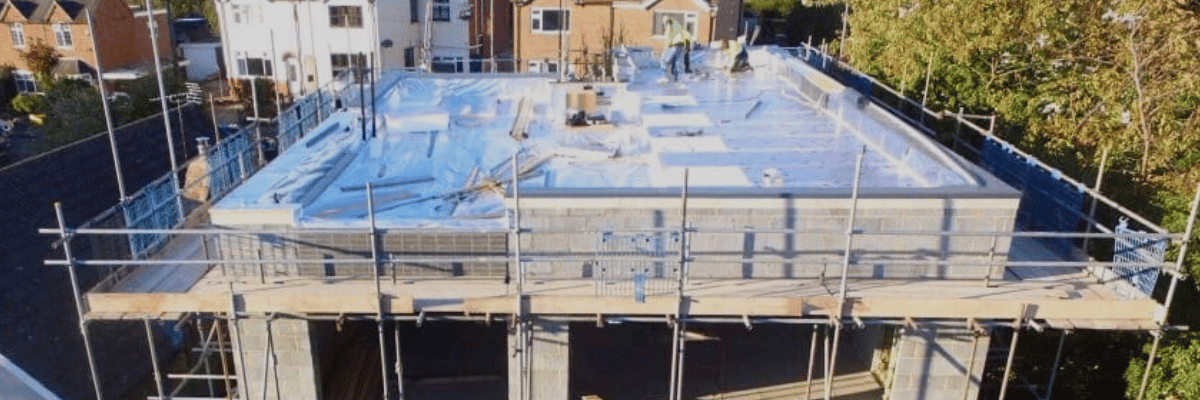
Typical scaffolding costs:
- Simple single-storey extension, from £750 + VAT
- Increasing height and complexity, £1,800 + VAT to £2,250 + VAT
4. Refurbishing, or a New Flat Roof?
Often in life, refurbishing is cheaper than buying new. Not with flat roofing.
Refurbishing an existing flat roof typically costs 10–20% more than installing one on a new-build property. It’s more complex, more time-consuming, involves waste removal, and usually means dealing with water damage to the existing structure.
Four things drive the cost of a refurbishment.
4a. Roof construction type
Is your roof a typical “cold roof” with a timber structure and insulation between the joists? Block and beam with screed? Woodwool slabs? Stramit? The construction determines the replacement process, and the cost.
4b. Existing structural condition
If a timber roof has been leaking for a while, expect some structural damage and repair costs. Repairs typically run from £150 + VAT up to £1,500 + VAT depending on how many joists need attention. Very few jobs need every joist replaced, so don’t panic. Just budget with your eyes open.
4c. The substrate
The substrate is the structural surface that carries the waterproofing: timber (chipboard, ply, OSB or planks), concrete, stramit or woodwool. If it needs replacing rather than repairing, that matters. Replacing and disposing of a 30m² timber deck costs between £1,800 and £2,700+ depending on complexity.
4d. The existing waterproofing
What’s coming off the roof affects the price as much as what’s going on. Mineral felt with reflective chippings that all need stripping and disposing of? Expect to add around £17 + VAT per square metre. A clean felt finish that can take the new insulation and waterproofing directly? Significantly less disruption and cost.
5. Your Chosen Roof Type
There are many flat roof systems on the market: old-school felt and asphalt, GRP (fibreglass), EPDM, single ply and more. Some last longer, some cost less up front, some insulate better.
Here’s how the main systems compare on lifespan:
| System | Typical lifespan | Relative cost |
|---|---|---|
| Commodity felt (merchant-grade) | 5 – 15 years | Lowest |
| SBS torch-on felt (manufacturer system) | 15 – 25 years | Low |
| Fibreglass (GRP) | 20 – 30 years | Mid |
| EPDM single ply, domestic adhered grade | 15 – 20 years | Mid |
| EPDM single ply, quality membrane well detailed | 25 – 30 years | Mid |
| TPO / FPO single ply | 25 – 40 years | Mid to high |
| PVC single ply, quality reinforced membrane | 30 – 40+ years | Highest up front, lowest over the roof’s life |
Notice that two of those rows say EPDM, and two say felt. That isn’t padding. It’s the whole point. The same system name covers products with completely different working lives, depending on the grade specified and how well it’s detailed. A merchant-bought felt and a manufacturer’s SBS system are both “felt”. They are not the same roof.
This is why the system name on a quotation tells you so little, and why the specification matters more than the category.
Why relative cost rather than a price per system? Because we don’t price by system. We price by roof. On any given job, access, height, the condition of the existing structure and the amount of insulation needed will move the figure far more than the choice of membrane does. Two 30m² roofs can differ by £6,000 before you’ve even chosen a system.
So the honest guidance is this. Find your size band in section 1, then expect felt to sit toward the bottom of that range and single ply toward the top, with GRP and EPDM in between. Anyone who hands you a per-square-metre rate card for each system either isn’t surveying properly or is planning to adjust the price later.
Read those lifespan figures carefully, because there’s a condition attached to every one of them. They reflect published industry and manufacturer figures for each system, but every one assumes competent installation. The material sets the ceiling. The installer decides whether you ever reach it.
That isn’t a throwaway caveat. A felt roof laid in cold, damp conditions with poorly sealed joints can fail in under half its expected life. GRP won’t bond to a substrate that isn’t bone dry, and a badly detailed job will delaminate within a few years. EPDM rarely fails in the middle of the roof. It fails at the seams and upstands, which is entirely down to workmanship. We’ve stripped off roofs that should have had fifteen years left in them and found the failure was never the material’s fault.
So when you compare a 25-year system against a 12-year one, you’re only comparing materials if both are properly installed. Otherwise you’re comparing lottery tickets. The lifespan figures above are what these systems achieve in the hands of a competent installer. In the wrong hands, every one of them can fail inside five years.
We install all of these systems. We’re not tied to one manufacturer and we don’t earn more by steering you toward a particular product. So when we recommend a system, it’s because it suits your roof, your budget and how long you intend to stay. Sometimes the honest answer is the cheaper system. If your roof has five years left and you’re selling next spring, we’ll tell you that.
The real question isn’t what the roof costs today. It’s what it costs you over the next 10, 15 or 25 years. A cheaper system that fails in a decade is the expensive option.
6. Waste Management Costs
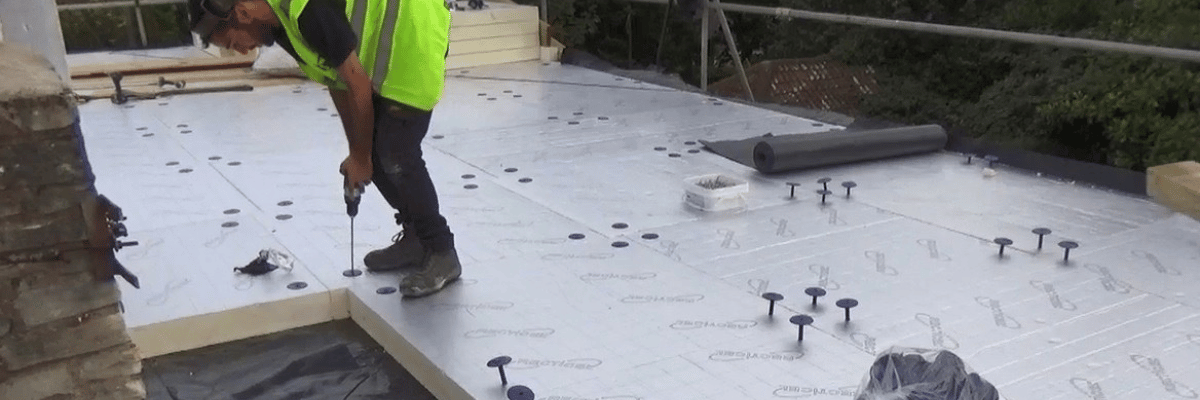
Waste removal is the cost most people forget. All the old material coming off your roof has to go somewhere, and a skip is usually the simplest answer. Most refurbishment jobs need an 8-yard skip, currently £350 + VAT to £425 + VAT.
7. Credibility, Quality & Guarantees
The final factor is the standard of the installer you choose, and it’s the one that determines whether every other pound you spend is protected.
The flat roofing industry has its share of unscrupulous operators who take your money and deliver a temporary fix. Or worse, a botched job needing immediate replacement.
A reputable flat roofing company will have:
- Recognised accreditation and a track record
- Proper back-office infrastructure to manage multiple jobs professionally
- A lengthy insurance-backed guarantee
It’s also worth asking who is actually behind the company, and what they’re qualified to do. Roofing isn’t just installation. It’s assessing structure, specifying the right system, and managing the work safely and legally from start to finish. Ask who on the team is responsible for those decisions.
Yes, a reputable installer costs more than a cheap “one man band”. But over the life of the roof, it can save you thousands in repairs, replacement, or structural damage from poor installation.
Back to the Price
Now that you’ve seen what drives the cost, here’s the summary again with a bit more detail.
- Typical extension roof, around 20m², straightforward access: most land between £8,000 and £12,000, usually with no VAT on warm roof work
- Small roofs, garages and dormers: typically £7,500 to £15,000, at a much higher rate per square metre for the reasons above
- Larger domestic roofs: use the bands at the top, then adjust for access, height, condition and system
- Commercial and large projects: from £5,000 to over £500,000, depending on specification, access and programme
If the number in front of you sits well below these ranges, that isn’t a bargain. It’s a signal. Go back through sections 3 and 7 and work out what’s been left out.
Are We the Right Contractor for You?
Honestly? Maybe not. And it’s better you know now than after a survey.
We’re probably not right for you if:
- Your only priority is the lowest possible price, and you’re comfortable accepting the risks that come with it. There are cheaper contractors than us. Some of the difference is efficiency. Most of it is what they leave out.
- You want the scaffolding skipped to save money. We won’t do it, and it isn’t negotiable, for all the reasons above.
- You need someone tomorrow. Good contractors have lead times. Anyone who can start immediately is telling you something about their order book.
We’re probably a good fit if:
- You want the job done once, properly, by people who are still trading when the guarantee matters.
- You value knowing exactly what you’re paying for and why.
- You’d rather hear an honest “that’s not the right system for your roof” than be sold whatever’s on the van.
- You want your roof assessed against evidence and scored, rather than someone’s opinion on the day.
We’d rather lose a job for being straight with you than win one by keeping quiet.
The V8 Roof Assessment
Everything in this guide comes back to one question. How do you know what your roof actually needs?
Most roofing companies answer it by having a look and telling you. We answer it with a process: the same one, applied to every roof, so the outcome doesn’t depend on who turned up or what they’d like to sell you.
We assess eight things:
- Compliance. Does the roof meet current regulations?
- Standards. Was it built properly, and has it been altered sensibly since?
- Design. Does it drain correctly, and are the details right?
- Safety. What risks does it pose to people and to the building?
- Buildability. If work is needed, how can it be done safely and efficiently?
- Future proofing. How many years has it realistically got left?
- Proven quality. What does the evidence show about its condition and past repairs?
- Sustainability. Can it be repaired or overlaid rather than ripped off and landfilled?
You get four answers:
- A condition score. The physical state of your roof today, as a percentage.
- A risk rating. The level of risk to your building, your property and the people in it.
- Remaining service life. An estimate, in years.
- The intervention required. What actually needs doing.
The most important thing on that list
The intervention scale runs: Monitor → Maintenance → Repair → Refurbishment → Replacement.
Four of those five are not a new roof.
If a roofer knocks on your door unannounced, or offers you a free inspection off the back of a leaflet, the answer is almost always full replacement. That’s the answer that pays. We’ve built a process that is perfectly capable of telling you your roof is in good condition, has fifteen years left, and needs nothing more than maintenance.
Sometimes that’s exactly what it tells us. We’d rather give you that answer and keep your number than sell you a roof you didn’t need.
And If You Do Need a New Roof: The V8 Design Process
An assessment tells you what your roof needs. If the answer is a new roof, or if you’re building an extension and there’s no roof there yet, the next question is how it gets designed and built.
Most flat roofs are never designed at all. Someone measures up, quotes a system, and fits it. That’s why so many fail. Nobody asked what the building actually needed before the material went down.
We run every new roof through eight steps:
- Discover & Understand. What you need from the roof, and the constraints we’re working with.
- Assess & Analyse. Condition, moisture, thermal performance, structure.
- Design & Solve. The right build-up for your roof, with the difficult details worked out on paper first.
- Comply & Integrate. Building Regulations, Part L insulation requirements, fire and safety.
- Plan & Coordinate. Access, scaffolding, logistics, and working around other trades.
- Specify & Document. The exact specification written down, so your quote is a fixed scope and not an open invitation.
- Deliver & Build. Installation, quality checks and site supervision.
- Handover & Perform. Final inspection, your documentation pack, maintenance plan and guarantees.
Why steps 4, 6 and 8 matter more than you’d think
Step 4, Compliance. Most replacement flat roofs over heated space must be insulated to current Part L standards. That’s a legal duty falling on you as the property owner as well as on the roofer. Get it wrong and you risk a fine plus the cost of putting it right.
Step 6, Specification. A written, itemised specification is what stops a quote drifting upwards once the scaffold is up. If your quote is one line and a total, there is nothing preventing “extras” appearing later. Ours is a fixed scope.
Step 8, Handover. You’ll receive a documentation pack including your Building Works Completion Certificate. You’ll need it to activate your guarantee, and you’ll need it again when you come to sell the house. It’s the single most commonly missing document in flat roofing, and its absence turns up at the worst possible moment.
Which Route Is Right for You?
There are three ways in, depending on where you are.
1. You know you need work doing → Free Flat Roof Survey
If your roof is leaking or you’ve already accepted it needs replacing, you don’t need us to convince you. You need a proper price.
We’ll survey the roof, produce a written Condition Report and Action Plan, and give you a fully itemised quotation. Free of charge, normally valued at £295 + VAT.
That’s a quote survey. Its job is to price the work accurately, and we don’t charge for it because its purpose is to win your business. Nobody should be charging you for a sales visit.
2. You don’t know what your roof needs → V8 Roof Assessment (paid)
This is a different service, and it’s worth understanding why.
A quote survey exists to price a job. A V8 Assessment exists to tell you the truth about your roof, including, quite often, that it doesn’t need replacing at all.
You get a structured assessment against all eight pillars, and a written report containing:
- Your condition score. The physical state of the roof today.
- Your risk rating. The risk to the building, its contents and the people in it.
- Remaining service life. An estimate, in years.
- The intervention required. Monitor, Maintenance, Repair, Refurbishment or Replacement.
This is a paid service, and here’s why that matters. We’re not quoting you for anything. The report is yours. You can act on it, sit on it, or take it to a completely different contractor, and we’d have no complaint if you did. That independence is the entire point, and it’s why it can’t be free. Free advice from a contractor isn’t advice. It’s a sales call with better manners.
If you go on to instruct us for the work, the assessment fee is credited in full against the job.
A V8 Assessment is usually the right call if:
- You’re not sure whether the roof needs replacing or just maintaining
- You’ve had a quote for a full replacement and want an independent second opinion
- You’re buying a property and want to know what you’re taking on
- You’re a landlord or managing agent who needs documented evidence of condition
- You’re planning budgets and need to know how many years you’ve realistically got
3. You need a new roof designed → V8 Design Process
For extensions, new builds, or roofs already confirmed for replacement. The eight-step process set out above, from brief through to handover documentation. Design work is included within your project quotation.
If a V8 Assessment concludes that replacement is required, the work already done feeds straight into the design. You don’t start again.
So Where Does That Leave You?
If you’ve read this far, you know more about flat roofing than most people who buy one.
You know roughly what your roof should cost. You know that every system carries risk, and that how it’s installed matters more than which membrane goes on. You know what to ask about scaffolding, insurance and specification. And you know what a suspiciously cheap quote usually means.
That might be all you needed. If so, genuinely, good luck with it.
But if you’re still not sure whether your roof actually needs replacing, that’s exactly the question a V8 Assessment answers. And if you already know it does, a free survey will tell you what it costs.
Either way, you’ll get a straight answer.
Call us on 01753 303775